Showing posts with label Black and White Films. Show all posts

Tuesday, December 11, 2012

Colorizing Films

Sometime in the past three years I obtained a collection of Shirley Temple Films. I have watched some of the shorter ones with my daughter, but yesterday was so blisteringly cold that we decided not to brave the outdoors after a trip to Target. We came home and decided to watch The Little Princess and drink Silk Nog.  

Imagine my horror when I turned on the film to find it was colorized. The shorter films we had watched previously were not colorized. I know that it is not always clear why colorization is so bad, so let me explain. To me films are works of art and not simply works of entertainment. When the films were made colors were chosen for the shade of grey that they would become when shot with black and white film. If you were to visit a set while they were shooting the colors would seem very odd. For instance to give the impression that women had deep red lipstick on the actresses actually wore a garish brown color that translated to what appeared to be a rich velvety red color on film. Directors of photography (DPs) trained their eyes to see in shadows and shades of gray as opposed to seeing in, so to speak, technicolor. It is an amazing skill that has for the most part been lost.

If you compare a black and white film shot in the last twenty years to one shot in the 1940s the difference is very apparent. Black and White Films nowadays tend to have a washed out look with many of the grays being similar shades. Contemporary DPs can see light and shadows, but are not as good at looking at colors and seeing gray. You can even see this in photography if you compare older photographs with newer ones. This also has something to do with film vs digital. Film can get a really wonderful, rich black color that digital just can't reproduce. Digital doesn't have the range of color that film has and it becomes very obvious when you are dealing with a gray scale because the grays start to match and you lose contrast. When you colorize a film some random colorist, completely disconnected from the film, is sitting at a machine deciding what color a dress the actress should wear, what color their hair should be, how green a tree is, etc. All of these choices were made previously by people collaborating on the actual film and are now being changed.

Not only is random color being applied to the film, but the choices that were originally made are being obscured. Sixty and seventy years ago film was not as sensitive as it is now and lights were huge and powerful. Painting with light (as cinematography can be referred to) was so much more difficult then and to see what DPs were able to do can be awe inspiring. They had to control the light in ways that we no longer have to; technology has made it very easy to shoot with available light and small lights. They had to think about every ray of light shining on to the set and they had no way of previewing what they were doing the way we do now with video assist or playback. You could walk onto a set and it would seem glaringly bright, but then when you watched the film the light would seem low and nearly dark. Past DPs really were true visionaries, even just the ones working on small B films or Shirley Temple films. When you colorize a film you lose all those details that they worked so hard to obtain.

Lastly, I believe it is beneficial to be appreciative of the past and those that came before us. There is a tendency to think that if something is new then it is better, if something is more expensive it is better, and so on. So often you get eye rolls about watching something in black and white, which makes no sense to me. I understand not being in the mood for subtitles (I've felt that way before particularly with a toddler running around), but black and white? I think a well executed black and white film is often significantly more beautiful than a run of the mill color film and is on par (and can even exceed) any of the great color films. I thought this argument had been made and colorizing films had been admonished (I can be so naive sometimes). In just the last two weeks I have run across two colorized films (when I bought Miracle on 34th Street the colorized version is publicized and the original B & W version is simply an "extra") and people are so nonchalant about it. I wonder if everyone would feel the same way if I suggested sprucing up some of Picasso's paintings from his blue period. They are kind of drab don't you think? Shades of blue? Wouldn't it be nice to add a little red? Some nice bubblegum pink would surely make them more appealing.

My daughter was so excited to watch Shirley Temple (she drinks that drink, as she repeatedly told me) that I continued watching and will no doubt watch it again. Our collection includes three discs so I am hoping that some of the other films are in glorious black and white.

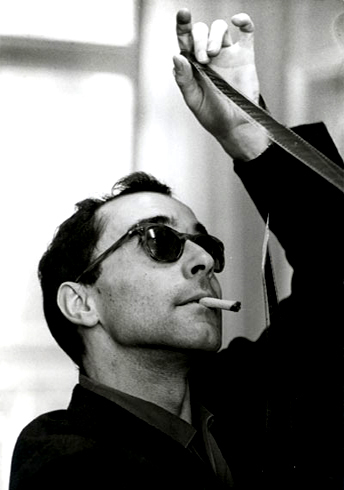
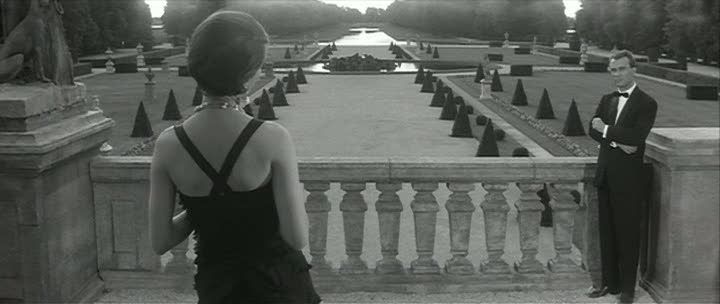
(Picture Sources:  Photo 1, Photo 2)

Monday, August 2, 2010

Monday Film Class: Movement vs Genre

For the next month or so I will focus on a specific area of film studies so that I can delve a little deeper into films instead of attempting to cover huge areas in one post. I will be looking at the Film Noir movement of the 1940s and 1950s. Some may say, "Hold up! Isn't Film Noir a genre?" To this I disagree and to understand why we must first look at the difference between a movement and a genre.

To accompany this post I pulled out some old photos that my husband took back in undergrad. In his photography class he did a Film Noir series and, yes, that is me posing in the photos many years ago. And that cigarette is just a prop.

Let's look at genre first. To simplify a genre is a way of categorizing films; yet if a film is a genre film it usually upholds certain stylistic/narrative/form rules. An easily identifiable genre is the romantic comedy or as some like to call it the romcom (isn't that cute?). To begin with I can think of many romcoms from many different decades (When Harry Met Sally, While You Were Sleeping, How to Lose a Guy in Ten Days, Miss Congeniality, etc.). Plot points in all of these films are strikingly similar: a man and a woman are introduced in the beginning, we want them to be together throughout, but, alas, the film keeps them apart until the very end when they realize that they are meant to be together. And we all rejoice when they kiss and breath a collective sigh of relief and a smile as we leave the theater. If this does not happen in the film then said film is not a romantic comedy. It may be a comedy or a perhaps a romance, but it's not a romantic comedy. There are a few other elements such as a big female star in the film (Julia Roberts, Sandra Bullock, Reese Witherspoon, usually the ones who are not great actresses, but big stars) and a somewhat unbelievable or whimsical plot.

Another easily recognizable genre is the western. Westerns have to take place, well, in the West, the American West that is. There is a battle of good vs bad with the good guy winning. The thing about genre films is that all you have to do is watch the film and you know that it belongs to that genre. You don't need to know anything about the director or when it was made or why it was made. The genre film stands alone.

So what is a movement then? Well, a movement is regulated to a specific time in history and is often reacting to an historic event or to a creatively stagnant film industry. While there are common elements in a movement not all the films necessarily adhere to the standards. Often the common elements have to do with the production of the films and not the finished product.

Since I have previously written about the French New Wave let's start with it. This movement really began with an article by Francois Truffaut titled "A Certain Tendency of the French Cinema," basically condoning the French Cinema at the time and throughout history to be fairly bland, boring, uninspired (with a few exceptions). The French New Wave constituted an immense amount of young, new, French filmmakers in the late 50s, early 60s. In a way they sort of woke up the French cinema. These filmmakers abandoned the idea of perfection and grandiose filmmaking. Instead they opted for small cameras, stylistic pieces, location shoots, and personal stories. To me there is real honesty in their films, which is magnified by how they really worked from the gut and took chances, embraced mistakes.

From my previous post there are two films that are synonymous of the New Wave: Breathless and The 400 Blows. If you were to casually watch these two films you would be hard pressed to find similarities that would put them into the same genre. Other than they are both French, take place in Paris, and shot in black and white. These similarities would include many, many films including the films that the French New Wave was rebelling against.  

Breathless is very fast paced and stylistic. The characters are hip, the scene is hip. Danger becomes fun. Godard experiments with cutting and with improvisation. On the other hand, The 400 Blows is more evenly paced and examines a rebellious childhood. It's an incredibly personal film that explores the filmmakers own childhood. So here are two very different films comprising one cinematic movement. An era that moved cinema forward a step or two. To understand how the films are connected and why they are part of the same movement you need some outside information. You need to know about the directors and about what was going on in the world. You need to know about the state of French cinema, etc, etc.

There is no seminal moment that I know of that inspired the romcoms. Other than some executives in an office realizing that a large group of people will pay money to see films were two people who are meant to be together are kept apart for an entire film before finally getting together in the end. Some would say that the screwball comedies of the 30s and 40s were the beginning of the romcoms, but I think there are even early films. Sherlock Jr. for instance is a perfect romcom. So as with westerns the romcom genre may have just appeared out of nowhere and always existed.

Finally, let's look at Film Noir. There is a fairly well agreed upon time period when Film Noirs were made. It's often cited that Noir films began with The Maltese Falcon and ended with Touch of Evil. These films were made in response to two major happenings in the world and Hollywood. In the early 1940s America was dragged into WWII, a place we didn't want to be until of course we were attacked and had to defend our honor. This attack and our subsequent use of the atomic bomb scarred the American psyche and the art being made had to somehow reflect this change. Fred and Ginger needed to be balanced by something a little darker, something unknown. Therefore, noir films tend to examine the seedy underbelly of the world. The characters are far from perfect; they're drifters, murderers, detectives, criminals.

Secondly, the Hollywood production houses, most notoriously Warner Brothers, needed to save a little money. They realized that they could reuse sets if they lit the sets with a lot of shadows using low key lighting. So the style was created due to a specific need. Though, it was also greatly influenced by German Expressionism of the 1920s; in these films areas of light and shadow were often painted onto the sets. Film Noir just used shadows to create intensity on the sets and mask that the same set was being used over and over again.

While there are many characteristics of a Noir film they by no means apply to every Noir film (other than Noir films always being shot in black and white). Color was very expensive at that time and, thus, would have negated the cheap feel of Noir. They may also include some of the following elements: a voice over, a femme fatale (a woman whom brings down the male lead), the main character dying at the end, Humphrey Bogart (not really, but he does seem to show up in a lot of Noir films).

Now, some of you may have heard of the term Neo-Noir. These are films made after the initial Film Noir time period and they are often shot in color. This alone is a fairly significant departure from the original style. Yet, though these later films take a lot from the stylistic/narrative form of Film Noir they are often missing the paranoia and even the melodrama associated with the original movement. While these new films are clearly influenced by the original films they are not similar in the same way every western is clearly a western.

Movements are also continually influencing films, filmmakers, and, even, other movements. For instance Italian Neo-Realism influenced the French New Wave. German Expressionism influenced Film Noir and so on.

Of course in the coming weeks we will look more in depth at Film Noir by actually looking at some films. In the meantime I hope this helps to allow you to think about movement vs genre. If you still think that Film Noir is a genre, I would love to hear your argument. I am always open to a well supported opinion. Also, remember that not all films have to belong to a movement or a genre, plenty of films exist outside of any type of box. So don't try to stick them in one. For instance just because a film has a female lead that does not automatically make it a romcom (for the record I consider romcoms and chick flicks to be the same thing, but that is an entirely new post).

Monday, July 26, 2010

Monday Film Class: The Great Cinema Myth

The first films ever projected were a collection of shorts by the Lumiere Brothers. Edison and the Lumiere's have a long running feud over who actually made the first film. I've heard arguments for both sides and personally I don't think it really matters. I call it a tie; though I do like to give the Lumiere's a slight edge just because it seems as though Edison tended to steal many ideas and inventions.

The Lumiere Brothers camera was amazing in that it was not only the camera, but also the projector. The simplicity of early cameras is amazing to me because you realize that all of the equipment that we burden ourselves with as filmmakers sometimes can get in the way of the idea. All you really need is a box, a lense, the sun, and a strip of celluloid (well, maybe an actor too). 

Legend goes that The Train Arriving at the Station was one of the first films shown the night of the Lumiere's screening and that the audience ran out of the theater screaming. Apparently, they thought the train was coming at them and would run them over. If you watch the film below, the train is not coming right at you, but steaming off at an angle. Audiences back in 1895 would have been extremely dumb to have run out of the theater after watching this film, do you not agree?

Research has shown that the audience did not run out screaming and if they did it was  a stunt to drum up publicity. I think as students it is important to consider this legend because its endurance relies on contemporary audiences looking at audiences of the past as somehow inferior. Simply because a film is old does not make it less important, less artistic, or less worthwhile. Perhaps it makes us feel better to look back at past audiences and think we are so much more intelligent. When in fact we are just interested in different things at different times.

When watching a Lumiere film it is important to still think about all the same elements as with other films. Why did they put the camera where they put it? How does it influence our viewing of the film? Why did they choose this subject? Early films are incredibly short so you can get in a significant amount of viewing in a fairly short time. All the films are in the public domain due to their age and are fairly easy to find on youtube.

Ironically, The Train Arriving at the Station was probably not even played on that first film screening back in 1895.

Monday, July 12, 2010

Monday Film Class: Last Year at Marienbad

I finally watched (or rewatched, the first viewing being in 1996) Last Year at Marienbad. Before I discuss the film itself let me give some background. The director, Alain Resnais, is associated with the French New Wave movement or La Nouvelle Vague. Of course the most prominent members of this movement are Jean-Luc Godard and Francois Truffaut. For those making a list of important films to watch you must include The 400 Blows (Truffaut) and Breathless (Godard). They are the truly defining films of this movement and The 400 Blows in particular is one of my favorite films. The French New Wave is truly independent filmmaking at its finest. Beyond that, though, the filmmakers were attempting to wake up cinema audiences. They were not concerned with allowing an audience suspend their disbelief and forget that they were watching a movie. Instead, they wanted the audience to always be aware that they are watching a constructed reality, a piece of art. 
 

        {Godard, Source}                                  {Truffaut, Source}

For instance they often use tracking shots that are way too long and make an audience uncomfortable or using a freeze frame at the end of the film so that all movement ceases and often the main character captured in a defining moment (of course now this technique is often used in a rather banal manner making it rather cliche). This was first used in The 400 Blows as a means to trap the main character and reflect on how he is caged and has nowhere left to go, thus using a cinematic technique to comment directly on a character. Godard used jump cuts (when a piece of the action is missing from a continuous shot making the image appear to jerk or jump) as a way to shorten his film, but it was also a means to constantly remind viewers that they were watching a film and had not been carried away to some other world. They are not a fly on someones wall, but instead a patron sitting in a theater.


The French New Wave is such a wonderful and influential period of filmmaking and I can only begin to touch on it here. Even though now  many of the techniques that they used in their films can be considered somewhat mainstream, the thought behind the technique has often been lost. When you go back and watch these films you can see what they were trying to accomplish more clearly. At times it can be uncomfortable to watch (not violent or sexual, but more 'what in the world is going on?'), but stick with the films and you will be rewarded. 


Now onto Last Year at Marienbad. Resnais is considered to be in a subset of the French New Wave often referred to as the Left Bank. These filmmakers, which also includes Chris Marker (La Jetee) and Agnes Varda (Cleo From 5 to 7), were the more artsy fringe of the movement. Though the French New Wave as a whole was interested in challenging tradition in cinema the left bank really pushed the envelope. While Godard and Truffaut were film critics taking the leap into filmmaking somewhat as a way to test their theories, the Left Bank contingency was made up more of artists. Their films sometimes even veered into experimental filmmaking.

To use a contemporary comparison trying to make sense of the plot or structure of Last Year at Marienbad is like trying to make sense of the television series Lost; when it comes down to it structural clarity is not necessarily the point. And believe me Lost is a cakewalk compared to Marienbad. Resnais is particularly interested in memory and his most famous films (Night and Fog, Hiroshima Mon Amour, Marienbad) explore the manner in which we store our most heinous memories be they personal or collective. For instance Night and Fog tackles The Holocaust and if land can maintain memory. Resnais brings his camera to concentration camps a decade after they were liberated and juxtaposes the modern footage with archival footage of the camps, thus taking leaps from the present to the past and back again. I first watched this film in 8th grade and the images, the sound of the narrator, were burned into my own memory. The two images that stayed with me most vibrantly was one of bodies being bulldozed (a painful image, but necessary)  and one of the modern grown over fence cutting through a green landscape.
Last Year at Marienbad looks at tragedy on a more personal level. The main character is trying to either rationalize his role in a rape and possible murder or his complicity in the murder of a woman with which he was/is in love. Depending on your interpretation perhaps there was not even a murder, perhaps the woman escaped with the love of her life at her side. Perhaps everyone is dead, portrayed only as a memory. Often Resnais jumps from one location to another, one moment in time to another during what appears to be one simultaneous conversation/thought. So the past and the present become blurred.


It is easy to write off Marienbad as weird and unfocused because it demands so much from its viewers. This is not an easy, popcorn film. All of the characters walk through the film in a daze, with little emotion to guide the viewer. Plot points and characters, who are never even named, are vague and barely developed. When watching the film you shouldn't try to make sense of it all, but experience it. Whatever you think is happening, is happening in some way,  allow your mind to fill in the spaces. There is not a right or wrong in this film.


This may be a hard film to watch, but it will stay with you as you ponder what it all means. You will benefit from multiple viewings, don't be scared to watch it twice. Sometimes when I watch films like this I get put into this dreamy, half asleep state that allows me to follow the film even better (and sometimes I fall asleep). If you have never watched a French New Wave film (or an experimental film) before I would advise watching some of the more accessible ones first before Last Year at Marienbad. 

If you give the film a chance you can really begin to think about memory and how we alter it to fit our perceptions of ourselves, our lives. Often if our memories were exact interpretations of what really happened perhaps we would not be able to exist in the world. Our actions would be to hard for us to bear. 

Monday, June 14, 2010

Monday Film Class: Buster and Charlie, Charlie and Buster

I full intended to re-watch and subsequently discuss Last Year at Marienbad, but unfortunately it is still sitting on the television. This week I haven't watched any movies though I have watched almost the entire second season of Party Down with my husband. Hopefully I will be back on track next weekend.

My recommendations for this week go back to the silent era. By watching silent films you can really learn everything you need to know about filmmaking. All of our visual cinematic language was truly created from about 1895-1927. It's often said, and I agree, that sound stunted the growth of cinema as an art form and if silent films extended their heydays by a decade the visual language of film would be exceedingly strong. Silent films are often even harder for students than foreign films. I can attest to this, when I was in college my film history class was a two semester sequence and the entire first semester was 1895-1927. We watched all the films on silent speed with no musical accompaniment. In reality silent films where not silent at all they always had at least a piano player and at times an orchestra. During the semester I thought it was torturous, but once you become accustomed to viewing silent films they are easier to digest and are very enjoyable.

The best place to start to ease your way into the silents is with the comics. Buster Keaton and Charles Chaplin are not only funny, but also superior filmmakers. They are also both extremely different. Buster Keaton does almost unbelievable stunts particularly considering this was before any safety measures. He also uses a lot of trick photography and symmetrical composition. His films are well planned out. Keaton is the master of the deadpan and relies more on the structure of his films than an emotional punch. Often Keaton is challenged by seemingly unbeatable odds; it's not one cop, but hundreds.

Chaplin, on the other hand, packs on emotional wallop. I don't think there is any film made before or after that matches the emotion at the end of The Kid. A while back there was a Bank of America Commercial (or some similar company) that used just the end of the film when Chaplin is racing across the city roofs to rescue his adopted child and I was tearing up. I didn't even have to see little Jackie Coogan. In his work Chaplin relies heavily on his supporting actors and would burn through magazines of film allowing for improvisation. He did not really script out his stories at length. He is most famous for developing the character of the "little tramp." The sweet, lovable, down on his luck clown has become iconic.

Pretty much any film you can pick up directed by one of these masters will be an experience. Be sure that they directed the film and are not simply featured. For Keaton I highly recommend Cops, Sherlock Jr., The General, and Steamboat Bill, Jr. For Chaplin: The Immigrant, The Kid, The Gold Rush, Modern Times and City Lights.  These are not exhaustive lists by any means, but I don't want to overwhelm anyone with silents. In my experience most students are wary of the silents, but Chaplin and Keaton helps to reduce their fears. Often students prefer one or the other and become very defensive of their chosen director. It is always a good class for me when a student who was vehemently opposed to watching silent films at the beginning of the semester sits in class arguing for Buster Keaton's composition and visual impact with another student who prefers the emotion of Chaplin.

Monday, June 7, 2010

Monday Film Class

 The thing about leaving a college is that when you leave there are still three years worth of students who know who you are and want you to stay. We are a small school, which makes it even worse. Those having the toughest time seem to be the juniors, particularly the ones that were my advisees. Two in particular, Courtney and Tashia, are talented filmmakers and want to keep taking classes. Courtney constantly asks me for a list of films for her to watch so that she can continue her studies. So here is a better solution (I hope) than just a list.

Every Monday I will discuss a film that I am currently watching, is a favorite of mine, or one that I believe is a need to watch. At times I may discuss a director instead of a film or maybe even a year (1939 was a particularly good one). There are so many films out there that are worthwhile both historically, artistically, and as legends. I have not even seen everything that I "should" see and, trust me, I've seen a lot of films.

After over a decade of a study in the field I have come to realize that there are two films that if you have not seen them and were to delve into a conversation with a serious cinephile you would be at a lost. Now these two films need to be watched alongside plenty of other films that cover all the decades; keeping in mind that the first film screened in 1895, not 1985. The films from the 1890s are very important and luckily they are short and sweet! But, on to the films for today, this first one should be obvious...

Citizen Kane (Welles 1941)


Surprise! Yes, you need to watch Citizen Kane. In a way it is like telling an art student they should really see the Sistine Chapel. You don't need to be told. Regardless, I'm starting at the beginning here. This is also an unranked look at two films. I am in no way saying I think Citizen Kane is the best film ever (for the record I don't believe that), I'm just saying you need to watch it to understand the scope of cinema. Kane is important for any number of reasons the big one that you will hear over and over again is: deep focus. Welles and his cinematographer, Gregg Toland, were very innovative in using the whole frame to visually tell the story even the background. Watch for the scene when a young Charles plays outside in the snow while his mother makes a deal regarding his life inside their house.

When first watching films it can be hard to understand how a story is told visually and when a story is not being told visually because film is a visual medium. This film should help you to see what can be done visually and why your favorite film last year may not have been nominated for an Oscar. Welles uses every shot in the film to say something about a character or to move the story.

On the Waterfront (Kazan 1954)


I watched On the Waterfront in more classes in college than Citizen Kane and I have undoubtedly shown it more often in classes that I have taught. It couldn't be more different, at least when looking at Hollywood movies, than Citizen Kane. While Kane is an epic visual powerhouse Waterfront is more personal with extensive location shooting. The acting plays the pivotal role in this film and the camera work often plays second fiddle. For instance in the famous white glove sequence where Marlon Brando improvised his actions after Eva Marie Saint dropped her glove. Kazan allowed the camera to continue to roll as Brando began to fiddle with the glove and put it on his hand. The symbolism is strong due to her innocent white glove and the action of him putting it on his hand. His guilt in the involvement of her brother's murder is in question and by taking her glove it can be seen to foreshadow his later actions.

Even though Kazan allowed his actors the freedom to improvise his film still has plenty of visual interest for instance when we see Charlie is revealed in the alley. Another interesting aspect of this film is that it can be read as Elia Kazan's explanation for his testimony at the HUAC trials where he named names. He had held out naming names for awhile and he never gave a clear explanation as to why he suddenly changed his mind and named names. All of the characters in the film can be substituted for various players in the HUAC trials notably with the Brando character representing Kazan.

Notice that both films are in black and white. It's important to not be scared of black and white; it's beautiful. Particularly in films before 1970 when the cinematographers really knew what they were doing when creating images with light and shadows. During my Introduction to Film class at the University of Colorado I overheard two girls planning on skipping out on the film because they couldn't handle all the black and white films they were being forced to watch. They did not understand why they couldn't watch recent movies. Of course, me being the film student snob I was, rolled my eyes and thought to myself, "Why are you even taking this class?" Counting films out just because they are not in color is a huge mistake some of the most amazing films were filmed in black and white. In fact if I were to add a third film to this list it would also be in black and white: Casablanca. Ironically, I believe the film they skipped out on was Last Year at Marienbad, which I just received from Netflix last week.